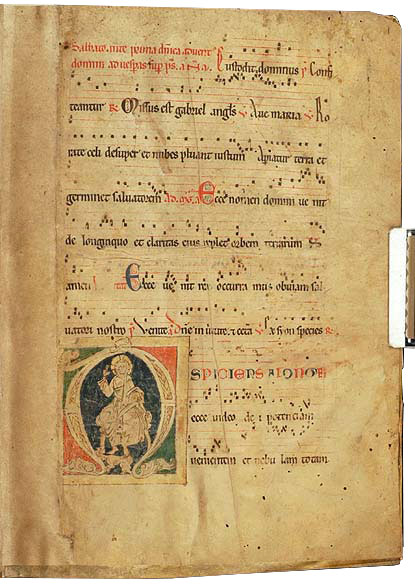
Link to image source: Antiphonary (MS M.966)
Western music in antiquity was not only heavily controlled by the church, but also memorized. Singers studied their craft for years and years, learning the chants they were expected to sing during services. Neumes acted as more of memory aides than music to be read; they showed the shape of the music with the absolute beginnings of specific pitches denoted.
These neumes were created and then spread through Western conquest, citing the need to ensure the Gregorian chants of that time were accurately taught in the expanding empire. The staff, in which actual pitches are depicted, is credited to Guido d'Arezzo of Italy in the eleventh century.
The staff at this time started with four lines, rather than the current standard five. This invention allowed singers to learn new and unfamiliar chants easier, but this did not negate the need for learning and memorization. Rhythm was not yet notated in an accurate way, so study was still an integral part of the slowly-evolving church music.
Rhythm started to become notated and developed closer to the 13th century, beginning at the Notre Dame School. Originally based on the Ancient Greek poetic meters, rhythm notation continued to evolve until each note was able to convey independent rhythmic values, known as mesnural notation, around the late 13th and early 14th centuries. Mensural notation was used up through the Renaissance and made way for even more artistic notation, such as arranging the staff into a shape; an example is Baude Cordier's 15th century composition Belle, Bonne, Sage, which is shaped like a heart.
The image above shows a chant for the First Sunday of Advent, which is the beginning of the liturgical year for the Catholic church. This manuscript is from around 1200 AD, handwritten by scribes in France or Germany. Note the use of red among the black marks; this often indicated the pitch F, but this was not always the case. No matter the exact pitch, the red offered a standard pitch around which the rest of the chant was read; colors and decorations (such as in the image) were often used as everything was still handwritten in this time.
Then, everything changed when the printing press... well, not attacked, but was invented. Read on.
E-mail: micah.wood@usm.edu
Created April/May 2026