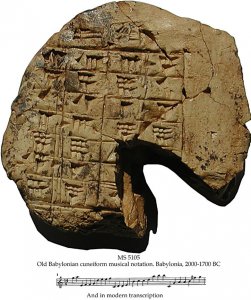
Link to image source: The Schoyen Collection
Way back before Guido d'Arezzo began the standard of notation that Western music utilizes today, there were cuneiform tablets. As the written word was being created and transformed, so too was written music.
In this time, clay tablets were used to notate gestures as used by the conductor of an ensemble, a technique known as "chironomy," the transcriptions of which are called te`amim. The academic thought is that this art was invented in Egypt, as far back as the Old Kingdom (about 2700-2200 BC). The gestures were indicating pitches to be sung or played, in a similar way to neumes (prevelant to the 9th-12th centuries AD).
The picture above is an example of Old Babyonian cuneiform music notation, from around 2000-1700 BC. According to The Shoyen Collection, it depicts two heptatonic scales intended for a 4-string lute tuned in ascending fifths.
Let's move forward into the 8th century, where things start to change more rapidly.
E-mail: micah.wood@usm.edu
Created April/May 2026