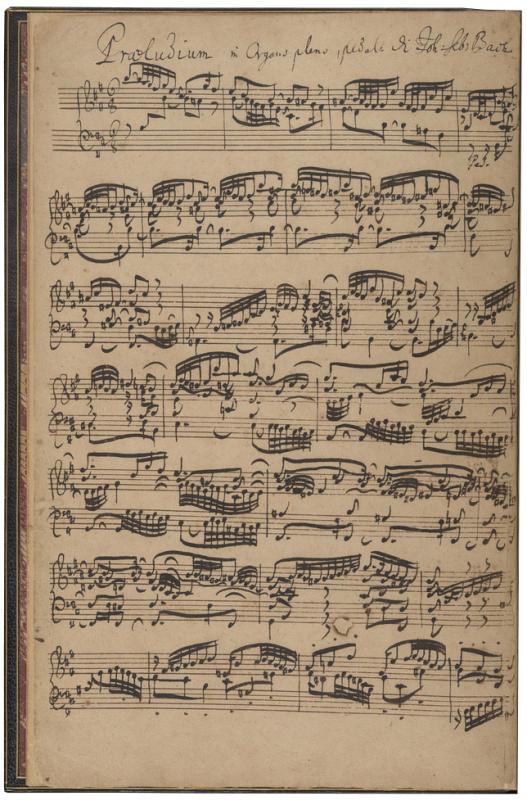
Link to image source: Millenium at the Morgan
The invention of the printing press in the 1400s really allowed music to evolve and spread past the confines of the church, even if the notation became a bit more boring. Printing in color was more expensive, so the decorations and colored lines/notes/words were replaced with black.
Since Guido's time, we have added a fifth line (circa 1300s) and instead of assigning a note to a line depending on the piece, the lines are instead standardized to represent a specific note across all polyphonic music.
The 1400s brought around the use of the bar line to measure meter, providing more precise notation and making new music even easier to learn. In the 1500s, the square or diamond shape of note heads became rounded, more of an oval, and time signatures were beginning to take shape. Note lengths were depicted shorter, as the long-winded chants were replaced by faster-moving music, requiring shorter denotions in rhythm.
The 1600s saw the rise of shorthand devices such as figured bass, dynamics such as forte and piano, and other ornamental signs. The 1700s saw graphics for dynamic changes such as cresendo, attacks such as staccatos, and other such phrase markings.
The image above shows Bach's Prelude and fugue for organ in B minor, BWV 544, from sometime between 1727 and 1731. The treble and bass clefs with their five lines apiece are depicted along with the key signature, short round-headed notes, and lots, and LOTS, of notes. You can see some dynamic/style marking up in the top right of the piece, but as graphics were just beginning to take shape, it's not surprising that we see little evidence yet.
With notation becoming more precise, the printed page proceeded to become more cluttered. The 1900s saw more power be given to the player to perform how they see fit, allowing more creative freedom. More precise pieces that may have diagrams, graphs, or mathematical symbols (such as with the rise of electronic music) is often too complicated to print into a readable score for publication and reproduction.
Music notation is still evolving today, making way for new music, new ideas, and new instruments. Some scores evoke the past with their artistic styles and even shapes of music, making them more art pieces than true readable scores. Just like any language, music will continue to evolve with the times and sometimes recycle old techniques.
E-mail: micah.wood@usm.edu
Created April/May 2026